
Entrepreneurs are often encouraged to compete for customers, contracts, funding and market share.
But in South Africa’s small-business ecosystem, collaboration may be one of the most underused pathways to growth.
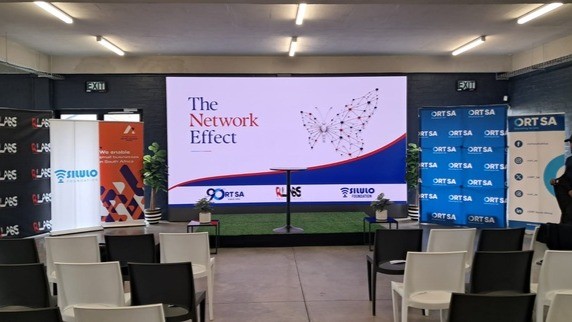
On Friday, 17 July 2026, ORT South Africa, Silulo Foundation and RLabs brought their entrepreneur communities together at the RLabs venue in Cape Town for The Network Effect.
Supported by the Astron Energy Development Fund, the event connected over 70 micro, small and medium enterprises from three established enterprise-development ecosystems.
The objective was not simply to host another networking event.
It was to demonstrate what becomes possible when entrepreneurs begin to see one another not only as competitors, but also as potential customers, suppliers, referral partners and collaborators.
Moving beyond the traditional networking event
Networking is often treated as an informal addition to entrepreneurship development.
Participants attend a programme, listen to speakers, exchange a few contact details and are then expected to build the relationships they need on their own.
The Network Effect approached this differently.
The event created a structured environment in which entrepreneurs could introduce their businesses, share what they offer, explain the challenges they face and identify areas in which they could support one another.
A caterer may meet an event organiser looking for a reliable supplier.
A technology business may connect with an entrepreneur who needs help improving their digital systems.
A designer, bookkeeper, marketing specialist or training provider may discover several businesses that require exactly the service they offer.
Two businesses may also realise that, by combining their capabilities, they can pursue opportunities that would have been beyond the reach of either business independently.
These connections are especially valuable for entrepreneurs whose immediate markets and professional networks remain limited to one programme, industry or community.
Three ecosystems under one roof
ORT South Africa, Silulo Foundation and RLabs each bring different strengths to entrepreneurship and skills development.
ORT South Africa works across education, digital skills, accredited training and enterprise development, equipping individuals and businesses with practical capabilities that can support sustainable economic participation.
Silulo Foundation works closely with entrepreneurs in township communities, including Dunoon and Khayelitsha. Its entrepreneurship programmes combine practical business development, consultancy, peer learning and access to a wider support network.
RLabs, uses technology, innovation, entrepreneurship and education to support community transformation, across 24 countries and five continents. RLabs geographical footprint shows how a locally developed social-innovation model can grow far beyond its original community.
Silulo Foundation and RLabs have also previously collaborated through EntrepreNXT, creating a foundation from which their entrepreneur communities can continue to connect and learn from one another.
Together, these organisations are linked to entrepreneurs from communities including Mitchells Plain, Delft, Philippi, Gugulethu, Dunoon, and Khayelitsha, among others.
Bringing those networks together allows opportunities and knowledge to move beyond the geographic and organisational boundaries within which entrepreneurship programmes often operate.
Collaboration must become part of enterprise development
During the event, Mona-Lisa Maposa, Chief Operating Officer of Silulo Foundation, shared insights into the importance of building sustainable entrepreneurial ecosystems through collaboration and innovation.
Ian Jacob, Head of the Skills and Enterprise Development Academy at ORT South Africa, led an interactive engagement on how strategic networking and collaboration can position small businesses for longer-term success.
“The future of enterprise development lies in collaboration,” said Jacob.
“When entrepreneurs begin to see one another as potential partners rather than competitors, they unlock opportunities that no single business could achieve alone. The Network Effect is about creating those connections and demonstrating the power of a collaborative ecosystem.”
This is an important shift.
Entrepreneurship support cannot be measured only by how many people complete a programme or attend a workshop.
The real test is whether entrepreneurs are able to apply what they have learnt, gain customers, access markets, improve their businesses and build relationships that continue after the programme has ended.
For that to happen, organisations need to create pathways between their programmes rather than operating as isolated support providers.
From separate programmes to connected pathways
No single organisation can provide every service, specialist, market connection or opportunity that an entrepreneur may need.
An entrepreneur may begin with basic business training, but later require digital skills, financial guidance, compliance support, market access, specialist mentoring or introductions to other businesses.
A connected entrepreneurship ecosystem makes it easier for that entrepreneur to move from one form of support to the next.
It also enables organisations to refer participants to one another, share opportunities, open selected workshops to wider networks and create joint platforms through which entrepreneurs can promote their businesses.
This does not require organisations to duplicate one another’s work.
It requires them to understand where their strengths complement one another and how those strengths can be combined to create more complete pathways for entrepreneurs.
The role of enabling partners
The Network Effect was made possible through the support of the Astron Energy Development Fund.
This kind of support matters because collaboration does not happen automatically.
It requires organisations to invest time in building relationships, aligning programmes, connecting participants and creating environments in which entrepreneurs can engage meaningfully.
Funders can strengthen the broader entrepreneurship ecosystem by supporting initiatives that connect programmes rather than funding only isolated interventions.
They can also encourage implementing partners to share learning, build referral networks and create opportunities that extend beyond the beneficiaries of a single organisation.
The Astron Energy Development Fund’s continued investment in enterprise and skills development has helped make collaborative platforms such as The Network Effect possible.
The network should continue after the event
The value of The Network Effect will not be determined only by the energy in the room on 17 July.
Its real impact will be seen in what happens next.
Do entrepreneurs follow up with the people they met?
Do referrals take place?
Do new supplier relationships develop?
Do businesses collaborate on proposals or projects?
Does an entrepreneur gain access to a market, skill or opportunity that was previously outside their immediate network?
These are the outcomes that turn networking into enterprise development.
The event brought three entrepreneur communities together under one roof, but its broader message extends far beyond Cape Town.
South Africa does not lack entrepreneurial ambition.
What is often missing are the connected pathways that allow entrepreneurs, organisations, markets, skills and opportunities to find one another.
When programmes connect, entrepreneurs gain access to broader networks.
When communities connect, markets expand.
When organisations work together around a shared purpose, the entrepreneurship ecosystem becomes stronger than any single programme could achieve on its own.
That is the real network effect.
To apply for the next cohort, fund an entrepreneur, sponsor the programme or get involved as a partner, please visit https://silulofoundation.org or contact the [email protected].
#SiluloFoundation #Collaboration #TownshipEconomy #Entrepreneurship #TownshipEntrepreneurs #BusinessGrowth #SmallBusiness #Leadership #CommunityImpact #SmallBusinessSupport #StartUpSupport