
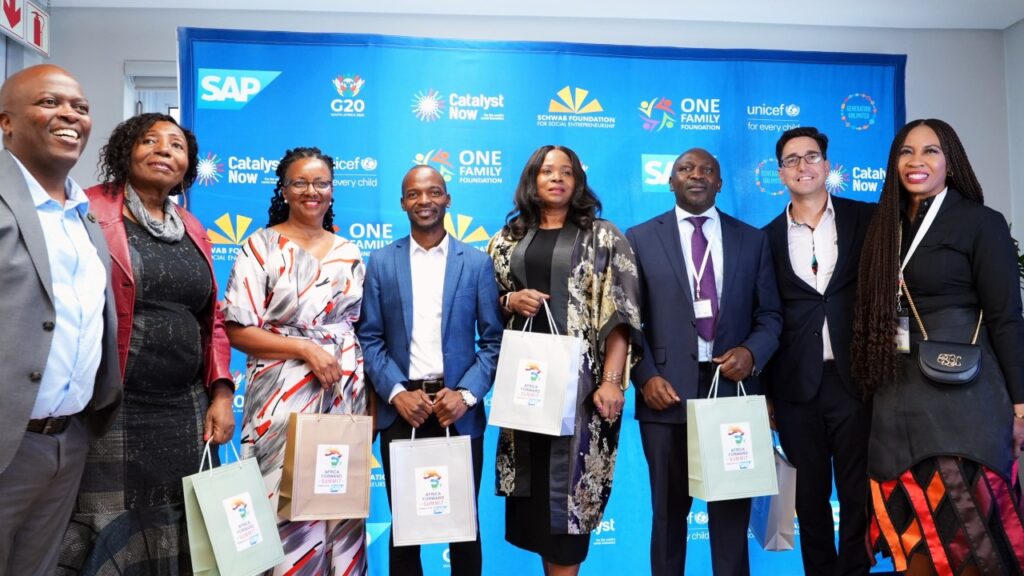
Last week at the G20 Social Summit in Johannesburg, something powerful happened.
Africa Forward Summit became an official side event to the G20 Social Summit – and, for the first time, Silulo Foundation live-streamed this historic gathering from our premises for our entrepreneurs and community.
In addition, the State of Social Enterprise report was launched at the event, produced in collaboration with the G20 Social Summit, SAP, the African Union, Africa Forward, and the Motsepe Foundation. For the first time in Africa, we now have valuable data on social enterprises! Dive into the insights and findings of this groundbreaking report by accessing it here: https://lnkd.in/eaZR4-eB
For South African entrepreneurs – especially township and grassroots founders – this moment is more than another conference. It’s a signal that our stories, data and daily hustle now sit at the centre of continental and global conversations about growth, jobs and justice.
Why this Summit mattered for entrepreneurs in South Africa
For years, township entrepreneurs have been building solutions in the shadows of the formal economy – creating jobs, feeding families and solving local problems with almost no visibility, data or policy support.
This new State of Social Enterprise report changes that. It reveals that:
- There are an estimated 2.18 million social enterprises across Africa
- Representing 17% of all businesses with employees
- Generating around $96 billion in annual revenue, and
- Creating 12 million jobs, many for women, youth and marginalised communities.
For entrepreneurs in South Africa, this is huge. For the first time, policymakers, investors and the private sector can no longer say, “We don’t have the data.” The evidence is on the table – and township and grassroots enterprises are clearly part of Africa’s growth engine, not a side story.
At the Social Summit side event and Africa Forward conversations, several themes kept coming back:
- Policy – How do we align national and continental frameworks (like the African Union’s 10-Year Strategy on the Social and Solidarity Economy) to unlock opportunities for social enterprises instead of creating barriers?
- Ecosystem building – How do we connect incubators, hubs, technical support and market access so that township entrepreneurs don’t walk this journey alone?
- Access to funding – How do we move from one-off grants and short-term projects to patient capital, blended finance and instruments that work for businesses in low-income communities?
- Youth employment – How do we support entrepreneurs who are not only creating products and services, but also absorbing young people into meaningful work?
These are not abstract questions for us at Silulo Foundation. They are the daily realities of the entrepreneurs in our programmes – founders who are trying to grow businesses while navigating policy blind spots, limited networks, and complex funding systems.
From running a foundation… to helping lead Africa Forward
For us at Silulo Foundation, being part of an official G20 Social Summit side event is more than a badge of honour. It’s a shift in role:
- From only running programmes at community level
- To also helping to shape the continental agenda on social entrepreneurship, youth employment and the social and solidarity economy.
It means:
- Bringing township entrepreneurs’ lived realities into rooms where policies and frameworks are being crafted.
- Using our experience – from digital skills training to our 10-month Entrepreneurship Programme – to show what practical, scalable support for grassroots entrepreneurs can look like.
Acting as a bridge between global platforms (WEF, AU, G20) and local entrepreneurs who might never board a plane to a summit, but who are building Africa’s future from spaza shops, garages and community hubs.
Our first-ever live stream of the Social Summit side event was an important symbol of this. It allowed entrepreneurs who could not attend in person to still be part of the conversation – to listen, reflect, and see themselves as actors in a much bigger story. Access is not just about funding; it’s also about visibility and participation.
What comes next: a call to action
This moment will only matter if it translates into action on the ground. Coming out of the Summit, a few commitments feel especially urgent for South Africa’s entrepreneurial ecosystem:
- Listen deeper to township and grassroots entrepreneurs: Design support with them, not for them. Their insights into what works – and what doesn’t – are our most valuable design tool.
- Unlock flexible, patient capital: Move beyond short-term projects. Social enterprises need funding that matches the rhythm of building real businesses in complex environments.
- Invest in skills and digital inclusion: Youth cannot participate in the future of work if they are excluded from the tools of that future. Digital, green and entrepreneurial skills must sit at the centre of our response.
- Build public–private–community partnerships that last: Government, corporates, social investors, foundations and community organisations each hold part of the puzzle. The magic happens when we align around shared outcomes – jobs, dignity and opportunity for Africa’s youth.
We leave the Social Summit and Africa Forward with deep gratitude – and even deeper responsibility.
To every entrepreneur in our Silulo Foundation community: Your journey is part of a continental story that is finally being seen, measured and celebrated.
Now, let’s turn this visibility into velocity – for your business, for your community, and for Africa’s future.
#AfricaForward #SocialEnterprise #YouthUnemployment #G20 #SiluloFoundation #TownshipEntrepreneurship #Partnerships #Innovation #YouthEmployment